Consulting Firm
Finance and Regulatory Matters
Turn Your Vision into Reality: Register Your Private Limited Company Today!
Register your startup company as private limited with Bhasha Advisors at the lowest Fees. Bhasha Advisors is an MCA (Ministry of Corporate Affairs) & MSME registered company in India. Our experienced (10 Yrs+) CA/CS will draft & complete all the documentations on the same day.
Overview
A private limited company (Pvt Ltd) is a popular business structure in many countries, including India. Out of total companies registered, around 90% of companies in India are registered under Private Limited Company. There are more than 175,000 companies that are being registered on a yearly basis. It is a separate legal entity with limited liability and perpetual existence incorporated now under the Companies Act, 2013. A private limited company offers a balance between limited liability protection and a structured business framework. If you’re looking to grow your business and limit personal risk, a Pvt Ltd company might be the right choice for you.
STARTUP INDIA
Bhasha Advisors is now recognized by Department for Promotion of Industry and Internal Trade under Startup India.
ISO 9001:2015 CERTIFIED
Bhasha Advisors is a ISO certified body, assuring the quality professional services to aspiring startups.
Eligibility to form Private Limited Company
- Number of Directors- Minimum 2 and Maximum 15.
- Number of shareholders- Minimum 2 and maximum 200. However, one person can act as both director and shareholder.
- Citizenship- At least one director should hold Indian Citizenship.
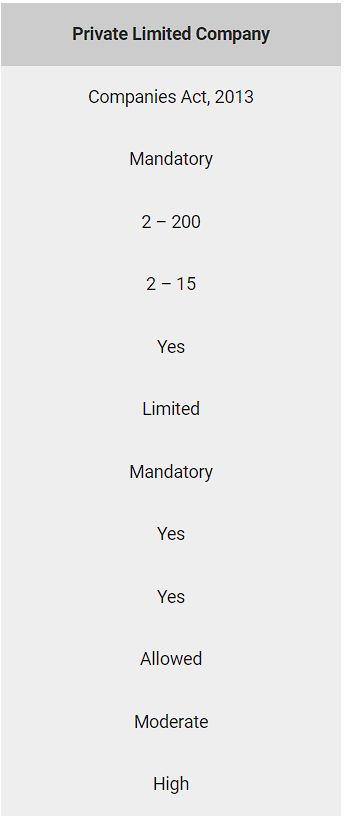
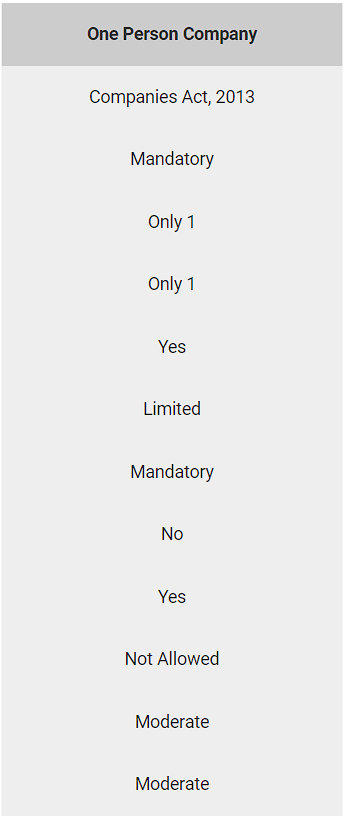
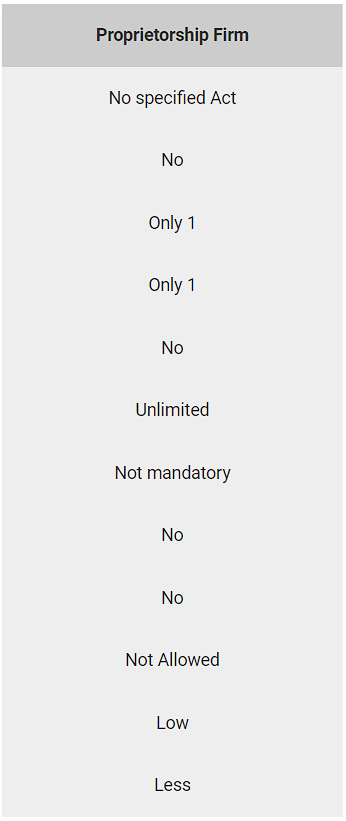
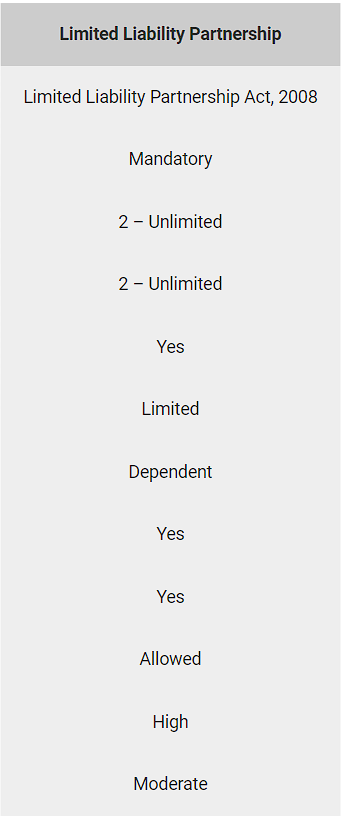
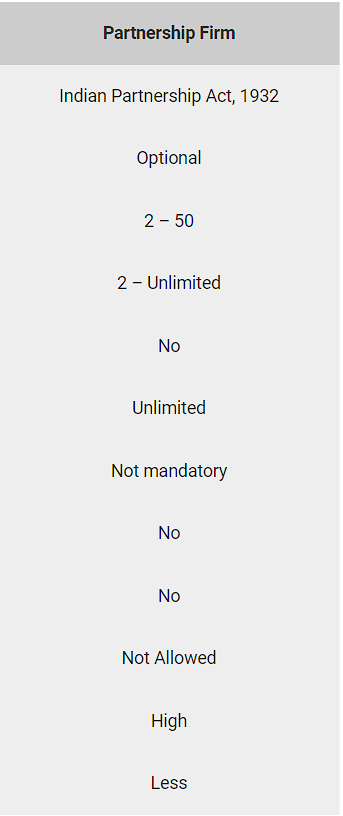
Comparison
- Act
- Registration Requirement
- Number of members
- Number of Director/Partner
- Separate Legal Entity
- Liability Protection
- Statutory Audit
- Ownership Transfer ability
- Uninterrupted Existence
- Foreign Participation
- Tax Rates
- Statutory Compliance


Testimonial

Devang Palan
Partner, Maneg Gems Art International (Authorised Distributor of Forevermark)

Vishal Patole
Director , Shree Samarth Beverages India Private Limited

Imtiyaz Jivani
Successful Entrepreneur , India Repz Services

Amit Mehta
Director, Lacolam India Private Limited

Nirav Karani
KPMG India, Assistant Manager, Indirect Taxes

Rahul Shreemal
Director , Citron Consulting | ex-PwC

Krishna Chamadia,
Director, Sphere Advisory Services | ex-EY
Required Documents
01
Passport Size Photograph
02
PAN Card
03
Registered Office Proof
04
Copy of Aadhar Card
05
Address Proof
06
No Objection Certificate
Our Fees
- Process
- Required Documents
- Benefits
- Tax Compliance
- Legal Advice
- Timeframe etc.
- Register your Private Limited Company with the Ministry of Corporate Affairs
- Assistance for opening bank account
- Company PAN & TAN
- MOA
- AOA
- Allotment of 2 DINs
- ESI and PF registration
- INC-20A commencement of business
- The 1st Board Resolution documentation
- Consent Letter drafting
- Appointment of the Auditor
- Register your Private Limited Company with the Ministry of Corporate Affairs
- Assistance for opening bank account
- Company PAN & TAN
- MOA
- AOA
- Allotment of 2 DINs
- ESI and PF registration
- INC-20A commencement of business
- The 1st Board Resolution documentation
- Consent Letter drafting
- Appointment of the Auditor
- GST registration (1 state)
- Register your Private Limited Company with the Ministry of Corporate Affairs
- Assistance for opening bank account
- Company PAN & TAN
- MOA
- AOA
- Allotment of 2 DINs
- ESI and PF registration
- INC-20A commencement of business
- The 1st Board Resolution documentation
- Consent Letter drafting
- Appointment of the Auditor
- GST registration (1 state)
- MSME Registration
- Brand registration under 1 class of trademark
* Exclusive of Government and stamp duty charges
Advantages of becoming a Private Limited Company
Limited Liability
If a private limited company was in financial trouble and had to close, shareholders would not risk losing their personal assets.
Helpful in Startup India Registration
Under the Startup India scheme you can avail lot of the benefits like raise the funds, subsidy for the trademark registration etc.
Easy transferable ownership
It is easier to subscribe or leave the membership of the company. Also it is easier to transfer the ownership.
Selling the business
As business Corporation value will be based on the business, not the owner, therefore making it easy to sell the company.
Perpetual Succession
The company shall continue to exist till it’s wound up in accordance with the provisions of the relevant law.
Raising Money
As per Companies act 2013 a company can sell shares to the public or can accept deposits from public and can therefore raise money easier than other business structure types.
Seperate Property
A Company as a legal entity is capable of owning its funds and other properties. The property of Company is not the property of its shareholders.
Better Governed
Companies are governed by the companies Act, 2013 and have to follow various other regulatory procedures during the course of its governance.
Compliances for a Private Limited Company in India
In order to get a compliance certificate for the private limited company registration there are various aspects that need to be kept in mind. Some of the elements are:
2 board meetings in a calendar year with 1/3rd of the total number of directors or a minimum of 2 directors. The minutes are to be recorded.
An AGM is required to be conducted every year and there should be a gap of 15 months between each of the two AGMs.
Appointment of the Auditor within 15 days of the incorporation of the company through Form ADT-1 to the RoC.
- Accounts to be Audited by a Statutory Auditor
- Filing of Form MGT-7
- Filing of Financial Statement (Form AOC-4 )
- Statutory Audit of Accounts
- Maintenance of Statutory Registers
- TDS/TCS payment
- GST payment and GST filing
- Other payments of periodic dues
- Filing of quarterly TDS returns
- Advance tax payment
- Filing of IT returns
- Filing of tax audit reports
- Tax audits
Process of Registering PVT. Ltd. Company
01.
Fill the form and make the required payment for the application.
02.
Post-Payment the experts will call back and proceed accordingly.
03.
A draft regarding how to register a pvt ltd company will be made.
04.
The DIN Number and the DSC will be applied for.
05.
AOA and MOA are the next document that needs to be submitted for approval.
06.
All documents are then sent to the Registrar Of Companies (ROC) of the concerned state for registration and incorporation.
07.
Once all the process is done it is just a matter of time before one gets to register a company.
08.
After the private limited company registration, the document is then sent to the person.
Popular Services
Online Legal Service
Tax Services
Trademark Registration
Accounting Advisory
Import Export Code
FSSAI License
GST Services
Company Registration
Why Us?
- On Time Service
- Super Fast Service
- Quick Response Team
- Data Security & Trust
- Affordable Than Other Professionals
- Trained and Professional Experts
FAQ
The Ministry of corporate affairs (MCA), Government of India reduced the fee for registering a private limited company, but you cannot register your business for free. The charges are minimal but they are not free.
The documents that are required for private company registration are-
Owner/Director’s Documents.:
- Directors PAN
- Directors ID proofs (Aadhar Card, Pan Card, Passports, Driving License)
- Directors Address proof
- Latest One Month Savings Account Statement
- Latest mobile phone bill or electricity bill.
- Passport size photograph
- E-mail ids
- If, Foreign Director International passport mandatory.
Companies Documents:
- Registered office address
- Company PAN Card.
- Lease or Leave and licence agreement if the land is rented or taken as leased.
- NOC from the landlord.
The One Person Company (OPC) may be transformed right into a Private Limited Company (PLC) as per Section 18 of the Companies Act, 2013 and the provisions of Companies (Incorporation) Rules of 2014. The conversion of OPC right into a private limited company will now no longer have an effect on the prevailing debts, liabilities, duties or contracts of the OPC. The necessities which are important for the conversion of OPC are changes withinside the Memorandum of Association (MOA) and Articles of Association (AOA) of the OPC (As consistent with the provisions supplied in phase 18 of the Companies Act, 2013, alongside phase 122 of the Act). For incorporating a personal constrained organisation there desires to be no less than contributors and directors. To follow for conversion of OPC to a personally constrained organisation, you want to fill the shape INC-6, to the Ministry of Corporate Affairs, Govt. of India.
The registration of a company is a scrutinizing process and thus there are few companies that get rejected under certain rules. Some of the rules are:
- The name does not align with the principles or objectives of the company.
- A translated name of a reputed brand name.
- Phonetic resemblance to an existing company
- Includes words that are offensive to any community.
These are some of the major points out of many other points of rejection.
Digital Signature is a digital code that is attached to the documents to signify equal authority as of the handwritten signature on the document. It is the proof for the authenticity of the document by the owner of the company.
Director Identification Number is an 8-digit identification number that is unique. It is allotted to every individual wanting to become a director or is already a director by the central government. The DIN Once allotted has a lifetime validity. The DIN helps the government keep track of all the directors. It is used on all official documents that requires the signature of the Director.
There are various types of company registrations that are available in India that one can register for: They are:
- One Person Company (OPC)
- Private Limited Company
- Public Limited Company
- Limited Liability Partnership (LLP)
- Non-Profit Organizations
Authorized Capital and Paid-up Capital? Answer: The Capita of a company is the money given by the shareholders to conduct the business activities. It is mandatory under the Capital clause of the Memorandum of Association (MOA). The main differences between the authorized capital and the paid-up capital of a company are described below.
Authorized Capital
- The Authorized Capital is the maximum amount that a company can legally authorize for the issue to the shareholders.
- The amount should be more than that of the paid-up share.
- Authorized capital can be augmented anytime with the prior permission of the shareholders.
Paid-up Capital
- The Paid-up Capital is the amount of money actually amount paid by the shareholders.
- Under the Companies Amendment Act of 2015, the requirement of having a minimum prescribed paid-up share capital has been removed.
For the registration of a company various documents are required to be submitted. The required documents are:
- Directors & Shareholders Documents
- Passport size photograph
- PAN Card Copy (mandatory)
- Address Proof (Any one of the below)
- Passport
- Aadhar Card
- Driving License
- Voter ID
- Residential Proof (Any one of the below)
- Bank Statement
- Electricity Bill
- Telephone Bill
- Mobile Bill
- Registered Office Address Proof Documents
- Office Property Ownership/Rental documents
- Address Proof of Registered Office Premises
Providing these documents will enable a smoother registration process.
Digital Signature Certificates (DSCs)in the age of technology has become an integral part. A DSC is required for signing a document or application digitally. There are various reasons why a DSC is required and thus based on their requirements, one can obtain any one of the following three classes of digital signature certificate in India:
Class-1 DSC: This class of DSCs is issued to private subscribers and individuals to help them in securing their email communications, and authentication of their individual identity.
Class-2 DSC: These DSCs are issued to company directors and other signatory authorities of a company/firm/organization.
Class-3 DSC: This class of DSC is useful for participation in e-Tenders and e-Auctions, conducted anywhere in entire India.
MOA stands for Memorandum of Association whereas AOA stands for Articles of Association. Both the documents are important sources of information for shareholders and other stakeholders of a Company.
MOA is used in providing information regarding:
- Name
- Aims
- Objectives
- registered office address
- the clause regarding limited liability
- minimum paid-up capital
- Share capital of the Company.
It helps understand the relationship of a Company with the others.
AOAs on the other hand helps provide the necessary documents when the company is incorporated with the Registrar of Companies (ROC). AOA and MOA in conjunction are called the Constitution of the Company.